


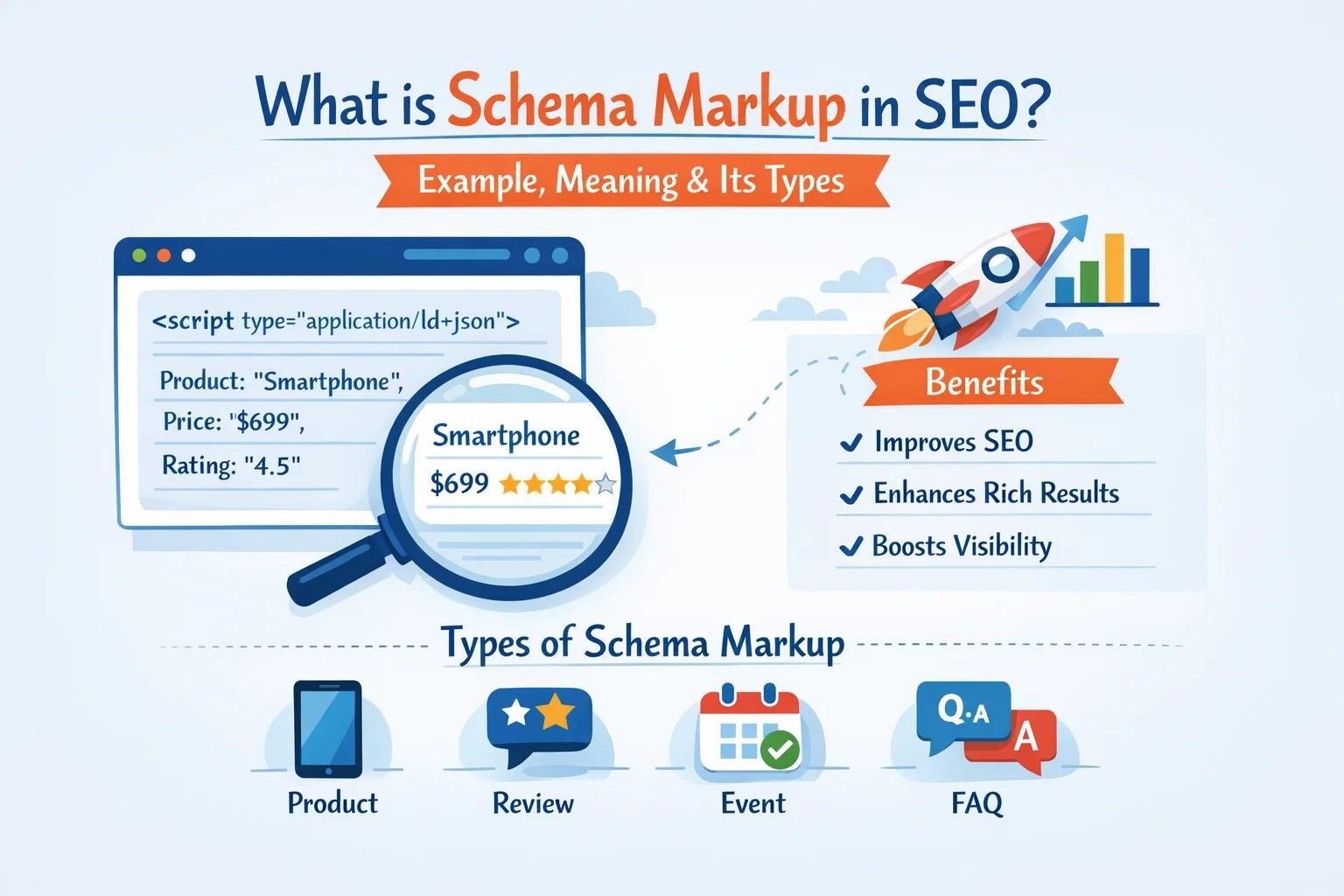
What is Schema Markup: A Detailed Guide to Understanding Its Importance and Types
Digital marketing and content experts, it’s time to stop thinking of content optimization as merely on-page and off-page SEO. There’s another aspect to your content: the technical one, and an important part of this is schema markup.
With the emergence of AI Overviews and other tools like ChatGPT, Gemini, and Perplexity, how you optimize your content has changed completely. One of the most important aspects that ensures your content is scanned and cited correctly is schema markup. Research conducted lately suggests that out of all the sites ranking on the first page of search results, 72% are ones with proper schema. Yet, many website owners don’t want to spend their time working on schema markup. They see it on the checklist, prioritize other ranking factors, and ignore schema conveniently.
Another research study, actually an audit published by Digital Applied in April 2026, mentions that 71% of 5,000 websites deploy at least one schema type, but only 22% pass Google’s test on rich results. What does this imply? While most people are doing schema, they aren’t doing it currently enough to benefit from it. This makes it important to understand what is schema markup, what are its different types, and which ones matter the most.
Why Schema Markup Matters for AI Search in 2026
Without schema markup, inferring the meaning from the content becomes the AI system’s responsibility, which modern AI is absolutely capable of doing. However, with schema markup, you simplify the process. It is observed that when two pages cover the same topic, the one with clear schema labels will be easier to extract from and have more potential to be cited. This is because schema markup tells AI exactly what the content is, who is its author, and what queries it is addressing.
In 2026, schema markup contributes to 20 to 40% more click-through rates through rich snippets. Still, from 2025 to 2026, there was only a 37% year-over-year increase in the number of domains actively implementing structured data. This proves that many sites either still don’t have a schema at all or have incorrectly implemented it. So, with the right strategy, structured schema implementation is one of the best technical improvements for AI search visibility.
The Main Schema Types for AI Search: Which One Matters the Most
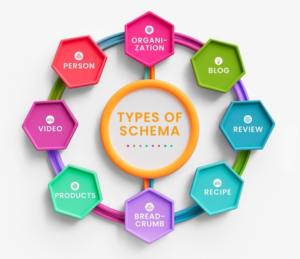
There are multiple schema types, but only some specific ones are important to boost the visibility of your content. The table below categorizes the relevant types, their purpose, and priority.
| Schema Type | Purpose | Priority |
| Organization | Establishes business identity, with a consistent name, logo, and contact details | Essential |
| WebSite | Defines your website, revealing the site’s name, URL, and core identity | Essential |
| WebPage | Describes each individual page and its relationship to the main site. | Essential |
| Article / BlogPosting | For blog and editorial content types, it contains the headline and author. | Essential |
| FAQPage | For frequently asked questions, organize questions and answers for high extraction by AI Overviews. | High Value |
| HowTo | For step-by-step guides, communicate tasks, required tools and supplies, and individual steps to search engines. | High Value |
| LocalBusiness | Local SEO details like business address, service area, and working hours. | Essential (Local Businesses only) |
| Product | E-commerce products, with descriptions, prices, availability, and ratings. | Essential (E-commerce Businesses only) |
| Service | Service pages, highlighting what you offer and to whom. | Essential |
| Person | Specifies the expertise and experience of the author, one of the core E-E-A-T signals. | High Value |
| BreadcrumbList | Site structure and hierarchy for navigation, helping AI systems clearly understand site architecture. | Essential |
| Review / AggregateRating | Customer reviews and ratings, generating catchy star ratings (average). | If Applicable |
| VideoObject | Video content, such as its duration, title, description, and thumbnail. | Recommended |
| ImageObject | Image content, including metadata that covers width and height, caption, and creator info. | Recommended |
| Speakable | Voice assistance optimization, marks content suitable for audio searches. | Optional |
Among these, some are more essential than the others.
-
Organization Schema:
Organization schema is your business’s identity, which tells AI systems your legal name, website URL, logo, contact information, founding details, along with the social media profiles. It is important because when people ask AI tools about your brand, they rely on your Organization schema to construct their answer.
-
Article and BlogPosting Schema:
The Article schema is used to assign your content to a general parent category and the BlogPosting schema is its sub-category. This is where schema markup and E-E-A-T overlap, because it is interlinked to the Person schema, which has the author bio and credentials essential for demonstrating trust, expertise, and authority.
-
Person Schema:
Person schema is where the E-E-A-T signal is present in the form of structured data. It shows that the individual writing the content has genuine authority and expertise in the topics they are covering and their insights are inspired by their own experience.
-
FAQPage Schema:

The FAQ schema for AI search ensures that the questions and answers appear directly in the search results. It is recommended that you add this to your service pages and in the help sections, so that the common questions are answered directly. This is also known to reduce friction for the users.
-
HowTo Schema:
HowTo schema is similar to FAQPage, but it applies to instructional content. With the right HowTo schema markup guide, you can mark step-by-step guides in such a way that the AI systems can extract individual steps, sequence them correctly, and surface them as instructions in the generated answers.
Best Practices for AI Search: What You Can Do Beyond Schema
The benefit of schema markup that everyone should know is: it makes your content interpretable, but is it solely enough to make your content citation-worthy? No. Here are some more practices in addition to schema implementation that can help you build content AI search systems trust:
- Use clear and descriptive headings in your content.
- Add a concise summary at the top of long articles.
- Include author bios on editorial pages for E-E-A-T signals.
- Build topical authority.
- Implement internal linking between related pages.
Frequently Asked Questions
-
Does schema markup alone improve AI search visibility?
No. Schema markup’s role is to make it easier for AI systems to interpret your content correctly, but to be cited, you need strong topical authority, accurate and comprehensive content, and E-E-A-T signals.
-
What schema types are most important for getting AI search visibility in 2026?
The highest priority should be given to schema markup types like Organization, Article or BlogPosting, FAQPage, HowTo, and Person.
-
Does schema markup replace the need for good content?
No, schema markup can make interpretation easier, but it does not make it authoritative, accurate, and trustworthy. Without these, your content won’t rank for both traditional and AI searches.
Conclusion:
Schema markup is one of the least-known aspects of a successful AI strategy, but it contributes to the foundation. In an era where search behaviors are inclined toward AI systems, a well-implemented schema markup for AI search ensures that your content is easy to reach for machines, just as much as it is for humans. However, schema alone is not enough to appear in AI-generated results in 2026. So, you should work on having genuine topical authority, credible authorship, consistent brand presence, and accurate content.
Want to work with a results-driven digital marketing and SEO Fulfillment agency that can help you build AI search visibility? Talk to the experts at Dynamix Digitech today!